If you're vegetarian, you'd better not watch - Leviathan
Ioana Satmari • 3/3/2025This documentary, filmed with a GoPro, 24 hours at sea, could be an email that would sound like this:
My dear Ariel, I’m here on the ship.
You should see how skillfully I split apart the wings of the stingrays. And how carefully I cut off the heads of the fish to make a big pile of leftovers. But the easiest part is opening the shells. So easy that I can light two cigarettes at the same time. But don’t think I’m the typical fisherman-sailor. One of the cigarettes, I give to my colleague, because I’m not stingy. You should know that my colleagues aren’t typical either. They don’t have bald heads, no mafia mustaches, and no mermaid tattooed across their arms.
I can’t wait to see you, my dear Ariel.
With love, Your Popeye.
In essence, Leviathan, directed by Verena Paravel and Lucien Castaing-Taylor, is like that friend who calls you but doesn’t really talk to you, but takes you around while cooking, shopping, and cleaning, and you’re just there to… be, but you don’t actually speak to each other.
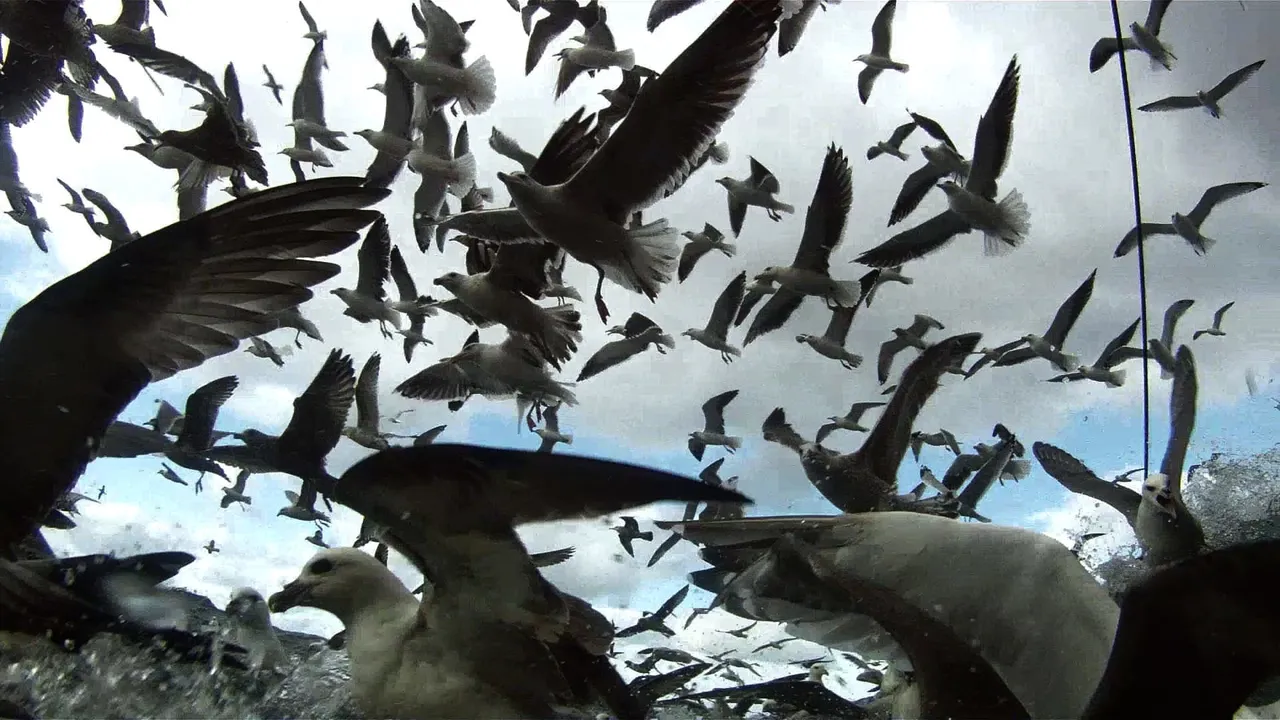
In medias res, and your mind starts running scenarios about what could happen for this film to make it through to the end. It begins with a scene lasting over 5 minutes showing waves of oversaturated, contrasting colors, where the water is a strong bluish green, and the light is a complementary orange-red. It gives the impression of an epic action movie opening, but it doesn’t take you anywhere near a least fragmented and scattered documentary. Ten minutes into watching, you still don’t know what it’s about, but the action-movie-at-sea idea has been lost in the waves. You wonder if you, not being familiar with fishermen and sailors, have missed the plot. You wonder this until you swim in water surrounded by fish heads with bulging eyes, swaying around you. And so you console yourself with the idea that maybe there’s no point in looking for meaning in everything. You just sit and wait to see what marvels it will show you next: fish piled on top of each other, struggling for survival, jumping over one another and swallowing each other. Fancy, right?
You get the impression that the directors thought of themselves as more artistic than they really are. That through the whole idea of indifference in the editing of the images, the documentary wants to be above everything, in that world we don’t have access to because we don’t know how the order of things works. Not to mention the shocking images of dead fish remains thrown into the water shot from various angles: from the boat, how they disappear into the water, from the water’s surface, how they fall and turn everything red, and underwater, how the color scatters. It’s like when we were kids and played with dirty brushes in the water.
The clumsy, smoky men are tired people used beyond their limits by a world that rests on their shoulders and asks for more than they can fish. The forced isolation of people and the compulsion to forced labor for the taste of the continentals loses its essence in the vast… sea.
Unfiltered, untended, and unshaven, it urges you, through the attention with which it is built, to be intellectually or artistically uninvolved yourself. From what I saw in Leviathan, directed by Verena Paravel and Lucien Castaing-Taylor, I came away with the idea that I watched (condensed) steam.