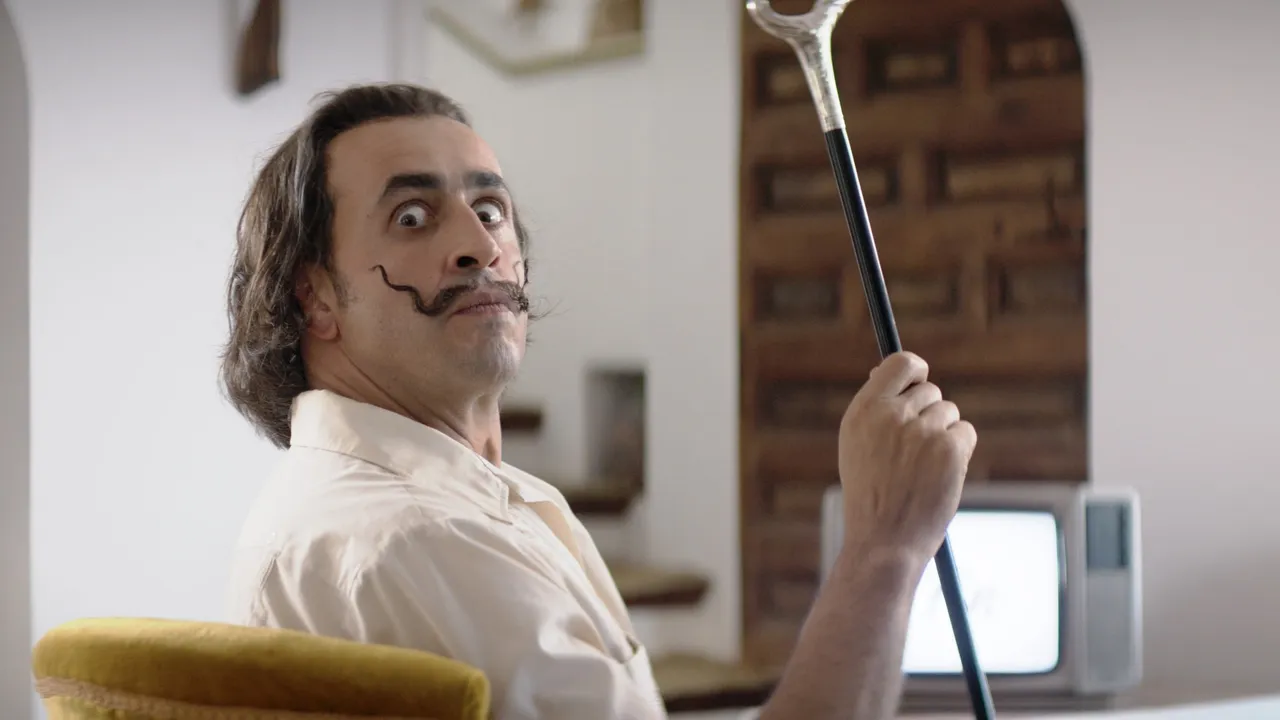
Puss in Boots in a French Inception - Daaaaaalí!
Ioana Satmari • 7/14/2024Of course, the signature comes at the end. The feature Daaaaaali! (directed by Quentin Dupieux), like a Puss in Boots pretending to walk a straight path only to end up as a Möbius strip, signed off (as in the poster for the 11th edition of the “Ceau, Cinema!” Film Festival) and concluded the festival.
Compared to the film Hors-saison (directed by Stéphane Brizé), which opened the 11th edition of the festival, Daaaaaali! fills in some gaps. Ethereal, clear, and vibrant, it brings to mind the rabbit hole from Alice in Wonderland. Even though things may seem disconnected, who cares? The world it brings you to doesn’t need subtitles; you just need to follow the whiskers (or the mustache?).
The hierarchical structure of the characters is the same in both Hors-saison and Daaaaaali!: the main, male character is in the spotlight, but through a subtle comparison with the supporting female actor. The story of Daaaaaali! unfolds along a long corridor where everything revolves around vanity. Well, maybe not everything —that’s a strong word— but a large part of his personality and artistic imprint, unlike anything seen before. If in the opening feature, Hors-saison, the atmosphere is cold, orderly, and difficult to grasp, Daaaaaali!, oscillating, precious, and bohemian, spins on an iridescent “planet” of the same name, where characters transfigure (Dali is played by six different actors, hence the many A’s in the title). The absurdity takes on different shades in the two films: from tarnished and muted to exuberant and explicit.
On Dali’s planet, time doesn’t melt like in perhaps his most famous painting but seems to coil up, much like the protagonist’s (protagonists?) mustache.
It’s summer. Arid, slightly magical, a place far from the world, the opposite of the milky-sand from Hors-saison. The same atmosphere is built in the characters. Mathieu chases after what could be an ideal, filling emotional voids with something that exists only in his mind. Dali has created his own reality. Neither sees beyond personal achievements and a well-worn ego. No matter how much of a satellite character, almost humble, Alice (Hors-saison) and Judith (Daaaaaali!) are presented to be in the two feature films, no matter how much they wish and try (Alice really tried), they can’t change something in someone who doesn’t realize what’s wrong. You can’t complete something in someone if that person doesn’t know what’s missing.
Judith (Anaïs Demoustier), newly a journalist, wants to interview the illustrious Dali (Edouard Baer, Jonathan Cohen, Gilles Lellouche, Pio Marmaï, Didier Flamand, Boris Gillot). The water needs to be at the ideal temperature with the CO2 bubbles counted, just to have a chance at proposing the interview. The story twists into a chase after him. Promises are made about his grandeur, starting with a ten minute interview that spirals into a full biopic involving an entire production team. I’m not sure where it begins, where reality is, and where the dream is —or if it even seeks a conclusion. I don’t think everything needs to be explained, we live with the impression that what we understand is what was conveyed anyway.
The structure of the feature film both presents and represents the nature of his paintings: abstractly vague yet explicit, slightly voluptuous, but nothing is deeper than you can handle. Returning once again to Alice in Wonderland, things can be as suffocating as they are imaginary.
Dali in the Liesland should be viewed with a extent of skepticism. You can believe it(/him), or not, or condemn it, but it manages to make you feel like you’re inside one of his paintings. It’s immersive. It’s a dream, within a painting, within a film, within a dream, within a painting, within a film…
A small disclaimer: if you’re the type who enjoys irony quietly, without the giggles and paralinguistic translations of the characters made by the people behind you, I highly recommend sitting in a corner of the cinema. Hors-saison starts off slow and rarefied, stretching out a thick boredom from which people try to free themselves by laughing at human irony. Daaaaaali! begins playfully and dives headlong into the rabbit hole from Alice in Wonderland. I’m not sure, but there’s a good chance Dali might have also tasted the biscuits on the rabbit’s table