Very demure, very mindful, and a splash of forest green - A Traveler's Needs
Ioana Satmari • 9/19/2024It starts documentary-like, improvised, and almost hard to believe at first. I say that because it’s handheld and rather pastel. But you check, and… no, it’s a drama. You keep two steps back and hesitate to get acquainted with Yeohaengjaui pilyo / A Traveller’s Needs, directed by Hong Sang-soo. Seemingly careless but subtly arranged, it feels like a film that doesn’t want to be watched. It’s bland, doesn’t call you, shy, like it doesn’t want to be noticed.
What if we lived in a world where we could only think about what we feel in another language? That’s what made me ponder. Here’s the setup: a French woman, Iris (Isabelle Huppert), is teaching French in South Korea. She carries herself with a calm detachment—she is who she is and stays that way. She kisses each cheek of everyone she meets, leaving the Koreans a bit stunned by so many bisous.
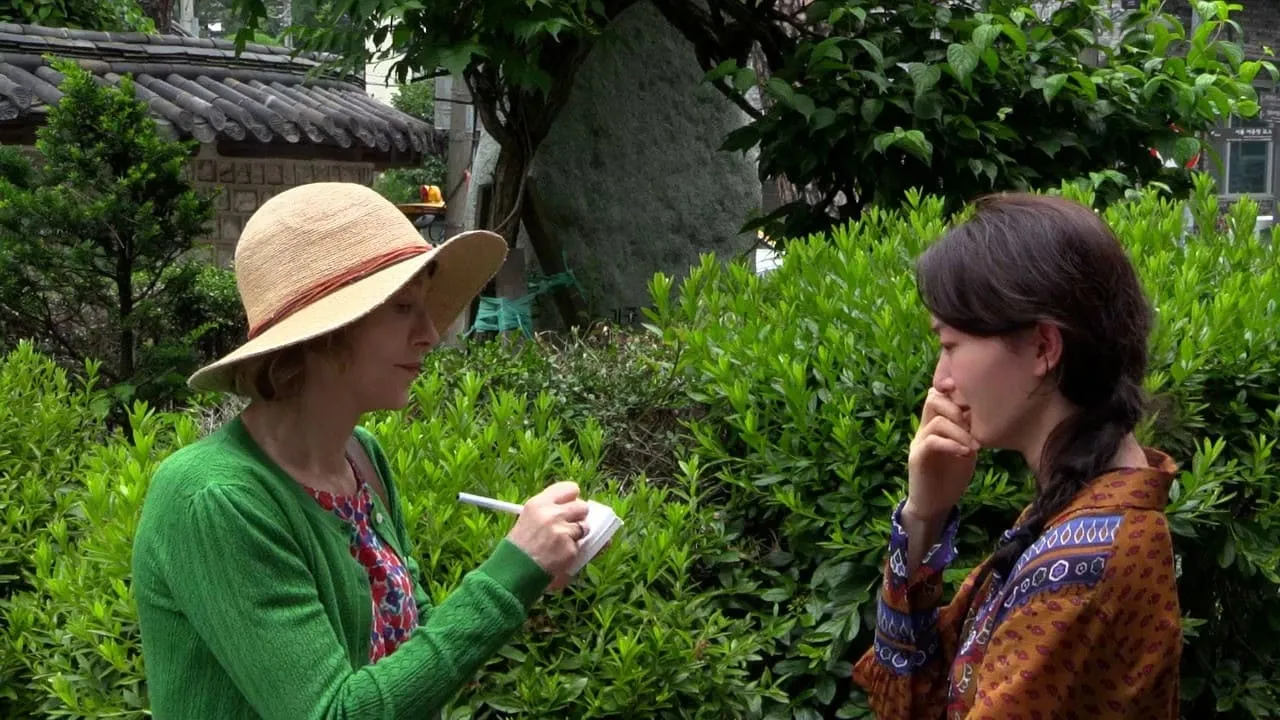
The film opens with a scene where Iris seems like a psychologist, jotting down French phrases on little slips of paper. She keeps asking the young woman sitting with her (played by Cho Yun-hee) about her feelings, especially how she feels when she plays the piano. The young woman seems unsure of what to say, struggling to express her emotions. Then we learn that it was all a French lesson. Then, Iris collects payment for her time and hands the young woman slips with the philosophical-metaphorical things she’d written in French. Iris is trying a new method of teaching French: if you manage to live and think about certain deep moments in another language, you create a much deeper connection to the words. What if we learned a foreign language just to say what we feel? To have a parallel language we use only for emotions, like emotions themselves are a parallel language between people. We don’t understand each other even when we say we feel the same things.
Iris moves on to a second client, a wealthy woman. The woman is skeptical. Who is this untrained, rather odd person? And she’s puzzled by Iris teaching without a textbook. Then she learns that Iris is still testing this teaching technique, and that this is only her second client.
This is where I felt the film’s preciousness. A scene repeats. Different characters: the young woman and the wealthy lady experience the same thing. The same discussion follows about what they played: the first on the piano, the second on the guitar. Iris’s questions are simple: How did what you played make you feel? It’s essentially the same question, slightly rephrased, asked insistently until they yield and talk about their feelings. They respond with the same exact words. At first, they evade—talking about the pleasure of playing well. Then, they mention the happiness of improving, of making fewer and fewer mistakes. Then the shift: they’re frustrated. The pleasure doesn’t compensate for the imperfection. Happiness is outweighed by the grinding frustration of not making mistakes.
The film lingers in a warm, eternal present, evoking nostalgia. The French woman is detached, yet deliberately whimsical. You may forget the events, but the idea of a supernatural language, one where we can stay hidden yet understand each other perfectly, lingers. Yeohaengjaui pilyo / A Traveller’s Needs is austere, rough, and compact. It’s bitter—a sweet kind of bitter, like makgeolli, the drink Iris frequently sips in the film.